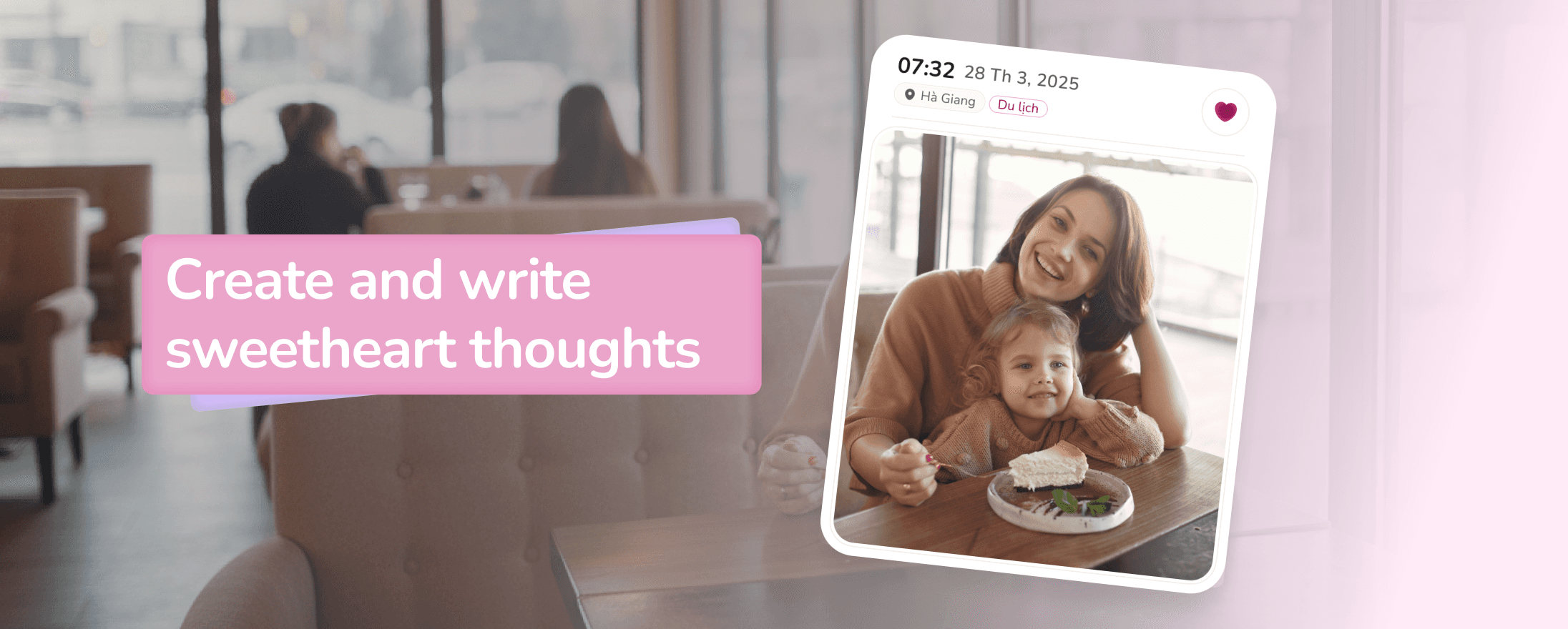
APPLICATION MOBILE / 2025
How to help mothers express their true feelings
Momii is a personalized journaling mobile app designed to help users build a meaningful daily writing habit. Users capture memories through text, voice recordings (with speech-to-text), photos, videos, and handcrafted Postcards, all stored in a personal cloud-backed space.
MY ROLE
Market Research
Architecture
Founding Product Design
TEAM
1 Product Designer work with PO
Product Marketers, Engineers
PLATFORM
App Mobile
CONTEXT
Running successfully a platform of specialized healthcare solutions, my client embraced a solution for the mental health of those who need care, such as mothers and the elderly. With the diary app market in Vietnam still having many gaps, the company has decided to embark on the journey to bridge the gap.
Build a journaling mobile app that helps users develop a daily writing habit. Momii is more than just text entries. Users can record memories using voice recordings (including speech-to-text), photos and videos, and handcrafted postcards, all stored in a personal cloud-backed space.
0->1 DESIGN PROCESS
Research Approach
In order to map out the entire emotional and behavioral landscape of the target Vietnamese mothers balancing the conflict between caring for others and caring for oneself, I conducted contextual interviews rather than asking potential users about their journaling habits or product preferences. Additionally, I studied one of the Big as Day One in-depth based on recommendations from The New York Times, Forbes, Time, and other market competitors.
Contextual Interviews
I avoided asking, "would you use this app?" Instead, we studied the emotional and behavioral context of daily life to see where the product truly fits. Conduct in-depth contextual interviews with target users around the topic "The hidden worries and concerns behind motherhood." Questions spanned 3 behavioral dimensions:
Daily Routines & Physical Habits
Self-Care & Emotional Expression
Reflection Practices
Mothers already reflect at the end of the day, they mentally review, talk to their partners or journal late at night but these moments are fragmented and leave no lasting record. The app doesn’t need to teach users how to reflect, it needs to make capturing that reflection frictionless.
The most often answer to the question "How many hours do you spend for yourself in the evening?" was 1-2 hours with passive consumption (phone, TV). Any journaling interaction that takes more than a few minutes can be abandoned. This was directly reflected in the multi-modal input design, is a 10-second-voice note should be valid a-500-word entry.
The questions about emotional sharing and self-observation revealed that many mothers believe they have put parts of themselves away since becoming parents. A journaling app for this audience is not a productivity tool; rather, it is a permission slip to remember who they are outside of motherhood. This realization solidified Momii's warm, feminine visual direction as an unavoidable design requirement.
Competitive Landscape
Notable apps in the journaling space reviewed during discovery: Day One, Daylio, Journey, ..
COMPETITIVE GAP
Most apps today are either text heavy (driving away casual users) or mood tracker light (too shallow for deep reflection). No one combined a warm aesthetic, multi-modal input and playful content discovery (swipe/scroll/calendar) into one cohesive experience.
Problem Statement
Build a journaling habit often stop journaling not due to lack of motivation but because the medium itself creates friction. Blank text editors feel clinical, physical journals are easy to forget, and existing apps don’t make the experience feel personal or rewarding.
Blank-page
Users don't know how or where to start a journal entry, especially on low-energy days.
Text-only input is limiting
Real memories include sound, images, and emotion that plain text cannot fully capture.
Passive storage, not active memory — most apps store entries but don't make it easy or delightful to revisit them.
Design Challenge
How Might We?
How might we make it easier to start a journal entry so that users feel invited to capture a memory or feelings in 30 seconds or less, no matter their mood or energy level ?
SOLUTION DIRECTION
Simplifying diary writing
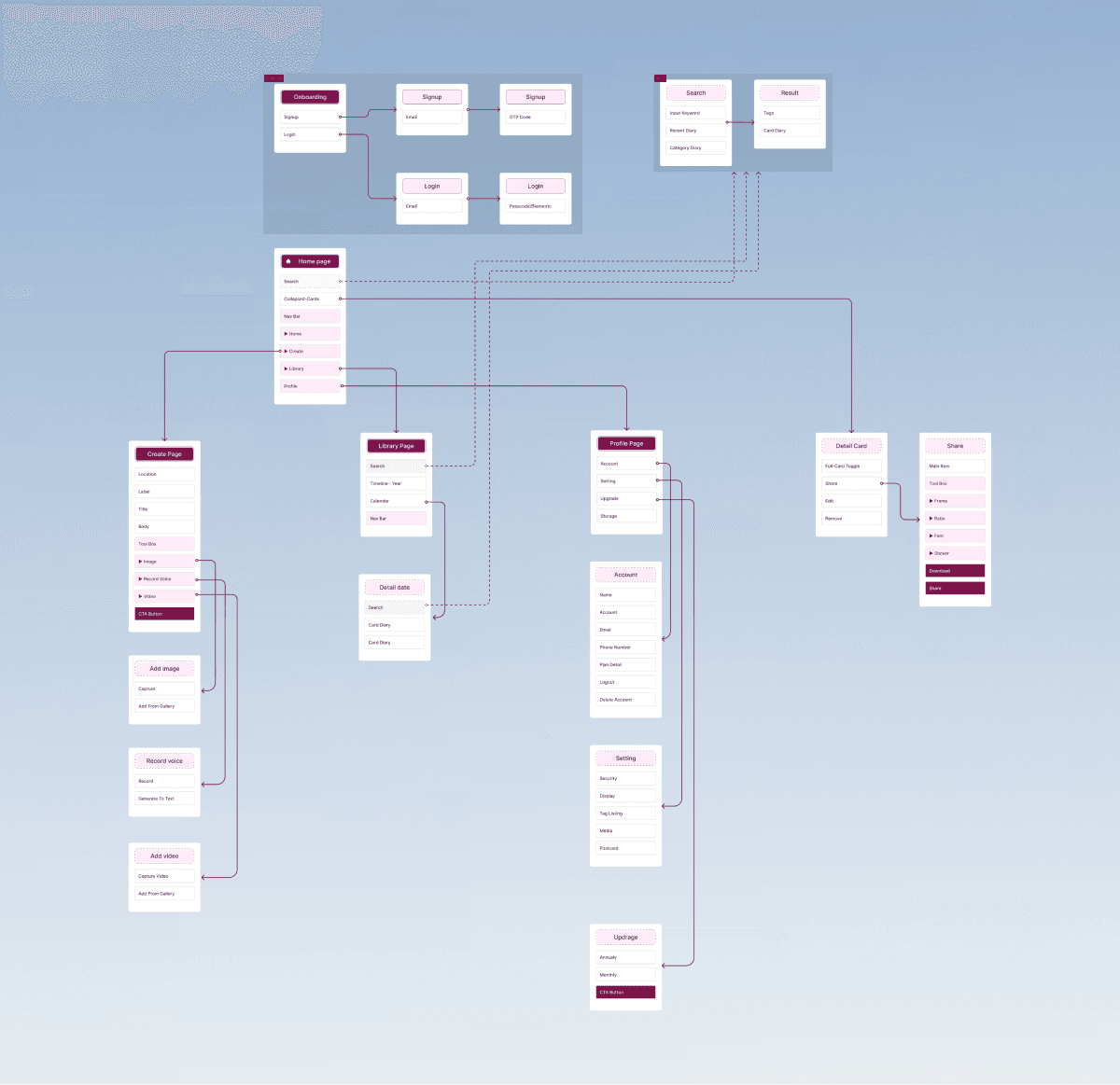
Momii was designed around a single primary action: writing a diary entry; with discovery and retrieval as secondary but equally important surface areas.
FINAL & Outcome
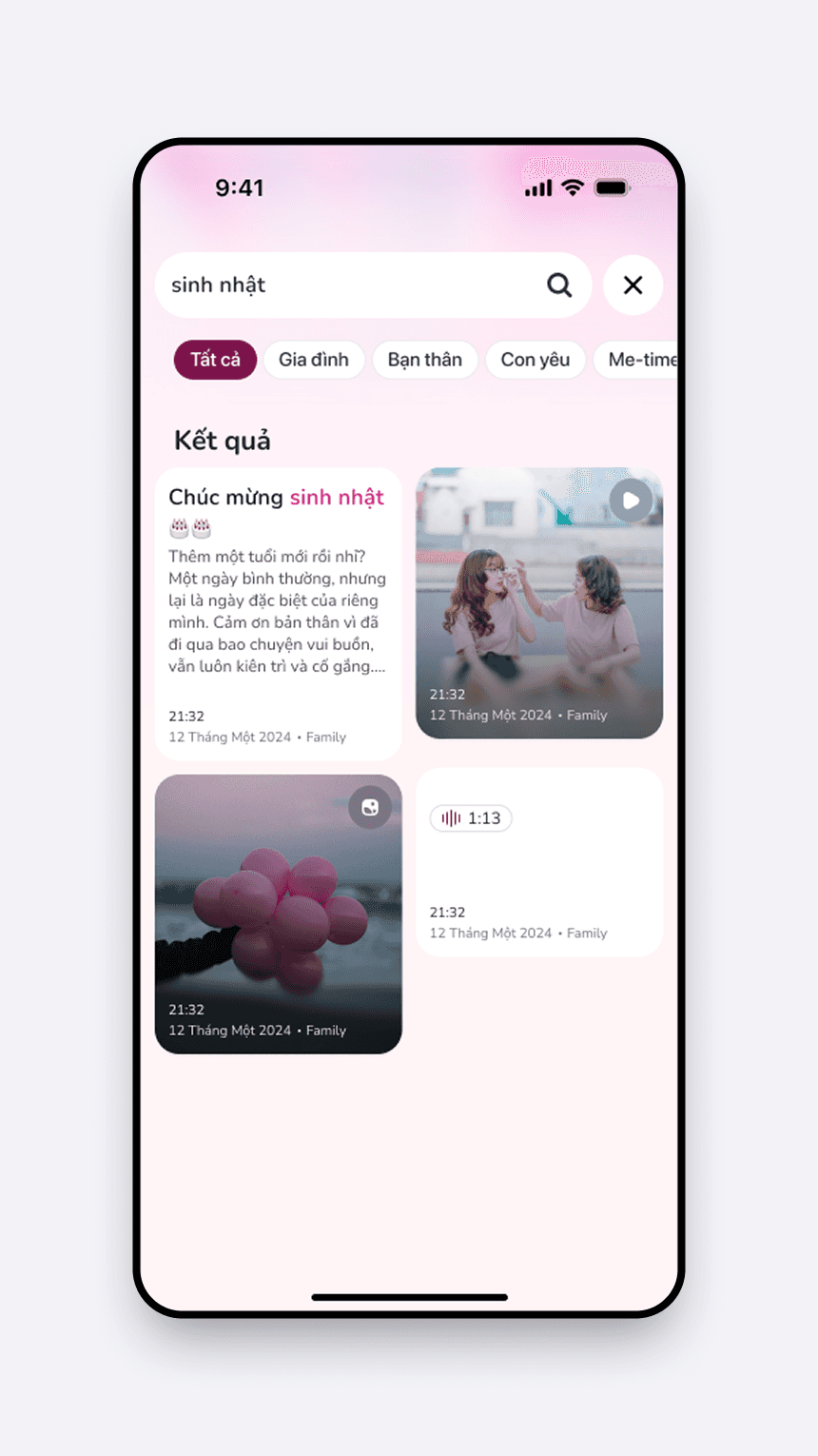
Explore & Review
Pre-made card templates serve as the main CTA, designated to inspire users to create their own diaries. Every card is every slice of life.


Write a diary
A diary is designed to enable users to create ease of creation and ease of view. The design prioritizes simplicity and accessibility, making the diary a convenient tool for capturing thoughts, memories, and reflections anytime with minimal effort.

Wrap memories
A diary is designed to enable users to create ease of creation and ease of view. The design prioritizes simplicity and accessibility, making the diary a convenient tool for capturing thoughts, memories, and reflections anytime with minimal effort.


Delivery Outcomes
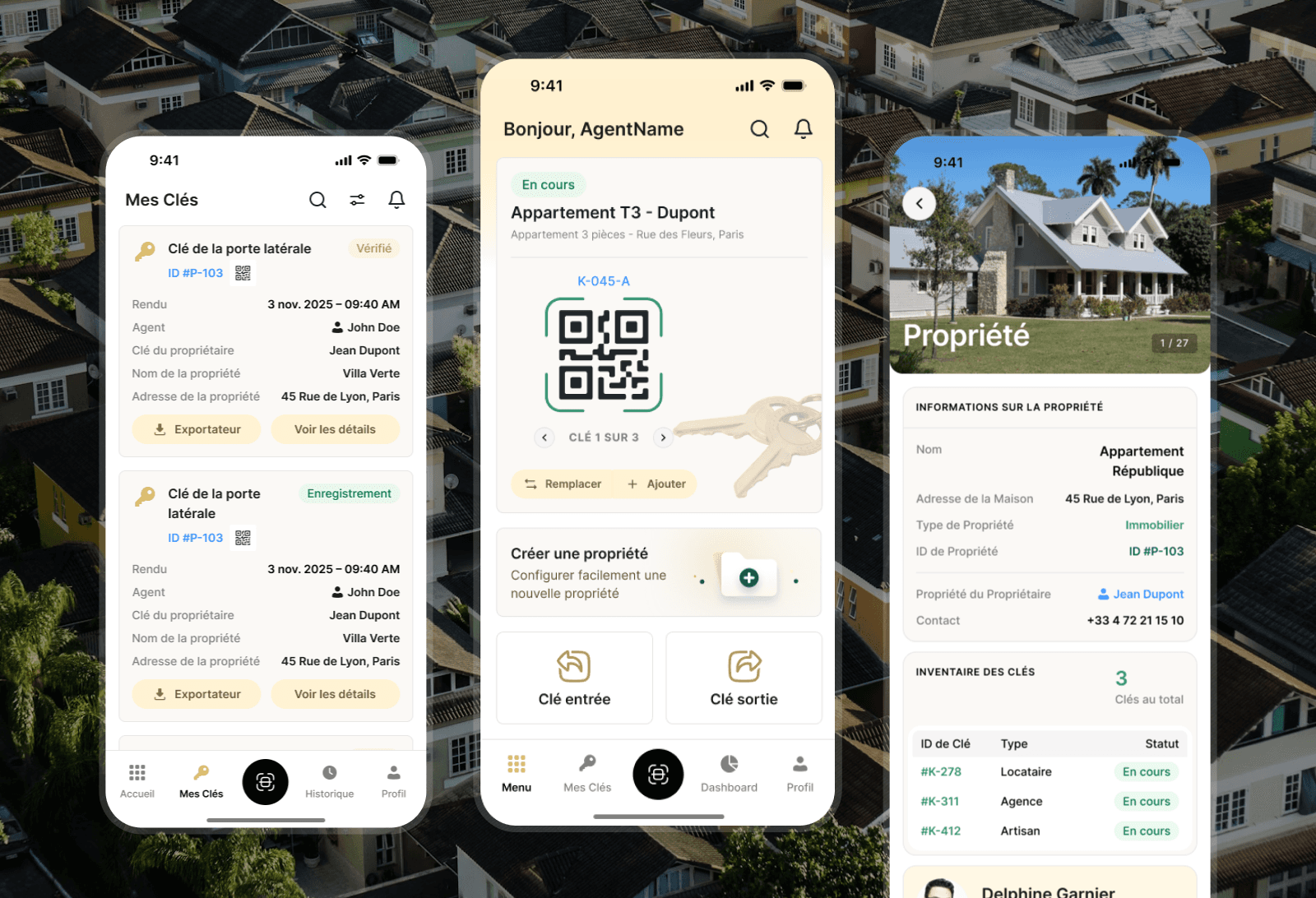
I delivered Momii Phase 1 with its core features completed. The outcomes below highlight the key milestones achieved during the design validation and delivery stages. These milestones demonstrate the thorough testing and iterative improvements made to ensure the product met its objectives and was ready for the next stages of development.
20
Core User Flows
fully designed & documented
98+
Screens Delivered
hi-fi, dev-ready
41
Components Built
in design system
What I learned from this project
Learn from product thinking
Reflect myself from a habit formation solution
Special Thanks
Kas Care Team
Every project is every experiment journey for me.
Meet and learn from people and lessons


" height="97.47829808315818px" id="hBxZIFJDa" transform="translate(0.292 0.038)" width="97.4927695368421px"/><path d="M 37.172 18.587 C 37.172 22.887 35.681 27.054 32.953 30.378 C 30.225 33.702 26.429 35.977 22.211 36.816 C 17.994 37.654 13.616 37.004 9.824 34.977 C 6.031 32.95 3.059 29.67 1.414 25.697 C -0.231 21.724 -0.448 17.304 0.801 13.189 C 2.05 9.074 4.686 5.52 8.262 3.131 C 11.838 0.743 16.131 -0.332 20.41 0.09 C 24.69 0.512 28.69 2.405 31.731 5.446 C 33.459 7.17 34.829 9.218 35.763 11.473 C 36.697 13.728 37.176 16.146 37.172 18.587 Z" fill="rgb(255, 158, 145)" height="37.17241379310424px" id="t0VVv_9Kk" transform="translate(30.042 30.046)" width="37.17241379310336px"/></svg>)